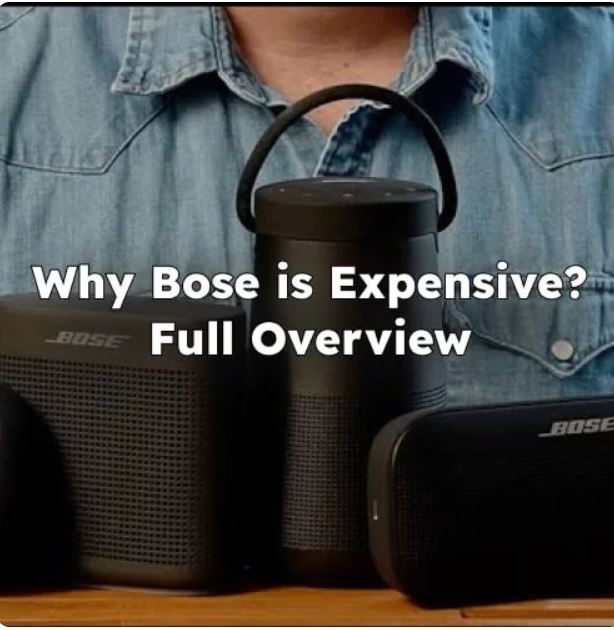
Why Is Bose So Expensive?
When you first pick up a pair of premium headphones or a sleek speaker from Bose and glance at the price tag, you might raise an eyebrow and ask: Why is Bose so expensive? It’s a fair question. After all, many brands offer decent sound for far less money. But the truth is, Bose is not just selling a “sound product”—it’s selling a thoughtful audio experience, backed by decades of research, engineering, brand positioning, and manufacturing discipline. In this article, I’ll walk you through why Bose tends to sit at a premium price point. I’ll break down the major driving factors, help you understand what you’re paying for (and what you might not be), and ultimately give you enough insight to judge whether the cost fits your own values.
- Heading 1: The Role of Research and Development
- Heading 2: Premium Materials and Manufacturing Quality
- Heading 3: Proprietary Technologies and Intellectual Property
- Heading 4: Brand Positioning, Marketing, and Consumer Perception
- Heading 5: Product Testing, Quality Assurance and After-Sales Support
- Heading 6: Supply Chain, Distribution and Scale Effects
- Heading 7: The Sound Quality and Listening Experience Premium
- Heading 8: Longevity, Resale Value and Total Cost of Ownership
- Heading 9: Regional Pricing, Import Duties and Market Factors
- Heading 10: Is the Premium Worth It? A Balanced View
- Conclusion
Heading 1: The Role of Research and Development
Bose’s heavy investment in research and development is one of the foundational reasons why the brand’s products carry a premium. The company has long prioritized innovation and aimed to refine the listening experience at a level that few competitors attempt. This includes both hardware—drivers, enclosures, noise-cancelling elements—and software: signal processing, tuning, adaptive algorithms. For example, Bose has invested in custom driver materials and advanced noise-cancelling systems.
Behind every new headphone or speaker there’s a team of engineers studying how humans perceive sound, how ambient noise influences listening, how small changes in design or material can alter clarity or comfort. That kind of work doesn’t happen overnight or cheaply. When a brand invests in “what you hear” and “how you feel” rather than just “how loud it is,” those costs eventually show up in the retail price.
Moreover, the development doesn’t stop after product launch. Bose often refines its models, updates firmware, tests new materials or configurations, and sometimes even applies learnings across its entire product line. This ongoing cycle of improvement helps maintain the brand’s reputation—and it helps explain why a Bose product might cost more initially compared to a competitor that uses off-the-shelf components.
In short, the cost of research and development is baked into the price. If you pay for Bose, you’re partly paying for the unseen hours of work, experiments, prototypes, tweaks, and refinements that aim to deliver better sound, better comfort, better reliability.
Heading 2: Premium Materials and Manufacturing Quality
Another major driver behind Bose’s pricing is the choice of materials and the manufacturing processes they use. When a company insists on “premium” rather than “acceptable,” costs go up. In the case of Bose, sources indicate the use of higher-quality components, tighter tolerances, more extensive testing, hand-finishing in some cases, and more stringent quality-control protocols.
For example, the speaker enclosures might involve special resonance-control bracing, or the drivers might use custom materials that are more expensive to source and manufacture. The headphones may include premium leather or memory-foam ear cushions, machined metal parts, or precisely molded plastics, all of which raise costs compared to more basic builds. One write-up pointed out that Bose’s manufacturing lines emphasise “precision over quantity” and that this drives up per-unit cost.
There is also the matter of durability. A product that is built to last, with parts that are tested for wear, resilience to heat, moisture or extended use, will cost more to produce. Bose appears to factor in support, extended lifespan and consistent performance as part of its value offering. Thus, when you buy Bose, you’re not just paying for the “nice materials”—you’re paying for the assurance of quality, and for manufacturing practices that make sure the product delivers over time.
Heading 3: Proprietary Technologies and Intellectual Property
One of the less obvious but significant factors is the role of proprietary technologies and patents. Bose has, over decades, built and integrated specialized audio technologies—noise-cancelling systems, waveguide designs, acoustic tuning approaches—that set their devices apart. These are not inexpensive to develop or protect. For example, Bose’s implementation of adaptive and active noise cancelling, its bespoke driver designs, and enclosure tuning all form part of its IP catalog.
Because these technologies are “owned” by Bose, they enable the brand to charge for differentiation. The presence of a name like “Bose” itself becomes a signal that you’re getting something more than “just another speaker”. That brand premium, enabled by unique features, means consumers pay more. It also means Bose must recoup the cost of developing and maintaining such technologies. Licensing, research, protecting patents, iterating—all of these add to overhead, which means higher retail pricing.
Additionally, the fact that some of these features are not easily duplicated by low-cost competitors adds to the cost justification. If you buy a Bose product, you are paying in part for “access” to these special features—not just hardware, but the algorithm, the tuning, the environment calibration. That also means that in markets where such features matter (aviation, professional use, frequent-traveller earbuds, premium home theatre) Bose can command higher price points because the incremental value is clearer.
Heading 4: Brand Positioning, Marketing, and Consumer Perception
Price is not just about cost–it’s about perception. Bose has for decades positioned itself as a premium audio brand, not a budget brand. That positioning influences everything—from design to packaging to retail experience and marketing. When you walk into a Bose store or open a Bose box online, you’re led to expect more: better finishing, better service, better sound. That typically comes with a higher price tag. One article points out that Bose spends heavily on marketing and branding, and that cost is built into the pricing.
Because of that premium image, consumers are often willing to pay more—so Bose is able to set higher MSRP (manufacturer’s suggested retail price). Some might say you’re paying partly for the “logo”, but in reality the logo is a shorthand for a set of expectations: sound quality, build quality, support, longevity. In business terms, the brand equity (the intangible value of the name) is part of what you pay for.
This brand positioning also means that Bose products frequently sell in higher-end retail stores, appear in premium packaging, may carry longer warranties or higher service support, and generally deliver a buying experience different from mass-market options. All these “extras” contribute to cost—not just the product you use, but the ecosystem around it.
Heading 5: Product Testing, Quality Assurance and After-Sales Support
It’s easy to think of cost purely in terms of materials and engineering, but an important hidden element is the cost of testing, quality assurance (QA), and after-sales support. Bose products tend to undergo more extensive testing than many budget alternatives. Testing for durability, sound consistency, noise-cancelling effectiveness, stability of wireless connections, performance across environments—all of these require lab time, skilled technicians, and sometimes special tools. As one article states, Bose’s “rigorous testing—covering acoustic performance, environmental durability, safety standards—ensures consistent quality but adds to costs.”
After-sales support is also part of the equation. When you buy a premium product, you expect a certain level of service: warranty coverage, firmware updates, replacement parts, reliable customer help. These support costs are factored into the product price. Put another way: part of what you pay for is not just “how this sounds today” but “what happens if it fails next year”. Bose’s business model appears to internalize that expectation.
Thus the price tag you see is not just for the device you hold—it also covers the infrastructure behind it: manufacturing checks, end-of-line defect screening, replacement parts, support staff, distribution logistics, returns, certifications. And that overhead is non-trivial.
Heading 6: Supply Chain, Distribution and Scale Effects
Another set of cost drivers relates to how Bose sources, manufactures, and distributes its products. Even if you design the best speaker or headphone in the world, getting it into the hands of consumers globally involves logistics, import duties, retail mark-ups, shipping, packaging, and inventory holding. Some of these costs scale poorly when you insist on premium materials, lower production volumes, or global distribution. For instance, smaller batch sizes raise unit cost. Several sources note that Bose’s supply chain—including customs, shipping, international logistics, and component sourcing—contributes to the premium price.
Furthermore, if Bose limits how aggressively it discounts or limits its availability to maintain brand exclusivity, that too affects the cost per unit. A brand that produces fewer units (or chooses not to produce massive volumes to hit the lowest possible cost) will have higher per-unit manufacturing and overhead costs. That then translates into higher retail pricing. Additionally, regional price variances (currency fluctuations, import duties, local taxes) can make Bose products even more expensive in some markets, and globally, the brand may choose pricing that protects its positioning rather than simply matching the lowest cost.
Heading 7: The Sound Quality and Listening Experience Premium
One of the main arguments Bose makes (and one of the core justifications for the greater cost) is the listening experience itself. When you buy Bose, you’re buying more than “a speaker that plays music” — you’re buying “how it plays music” and “how it feels to listen”. In reviews and commentary, Bose tends to be praised for clarity, immersive sound, noise cancellation (in the case of headphones), and the sense of “effortless” or “premium” listening. For example, review articles point to Bose’s high focus on sound quality—even emphasising how humans recognise audio and how the products shape themselves to our hearing.
Because of that premium sound expectation, Bose invests in tuning, acoustic measurements, driver‐enclosure interactions, and in some cases custom components. That means the cost of achieving that “special quality” is higher than making just “good enough” sound. If you listen carefully and compare a high-end Bose model with a budget product, you may indeed hear differences in clarity, noise floor, imaging, comfort or cohesion. Whether those differences are worth the extra cost is a matter of taste—but the cost is real.
Also, when somebody buys Bose, they often expect a premium listening environment: minimal distortion, stronger bass control without bloated sound, more consistent performance across volume levels and over time, and perhaps better isolation or noise removal (for headphones). All of that requires more precision, more expensive parts, and more design time than “average” audio equipment.
Heading 8: Longevity, Resale Value and Total Cost of Ownership
When you pay more upfront, one argument for a brand like Bose is that you might pay less over the lifetime of usage—not just the initial cost. In other words, buying cheaper gear might mean replacing it sooner, dealing with degraded performance, or receiving less support. If you factor in the total cost of ownership (TCO), a more expensive product that lasts longer, requires fewer repairs, has better resale value, and is supported longer, could make sense.
Bose’s build quality, service infrastructure and brand reputation tend to help with long-term ownership. That said, the extent to which each product lives up to this varies, and consumers sometimes feel the premium is not fully realized (which I’ll address later). But the expectation is: you buy once, you don’t worry for years.
Because of that expectation, Bose’s higher price reflects not only “what it does now” but “what you expect from it over time”. If a cheaper product fails or loses performance in a couple years, the effective cost per year of usage may actually be higher. So in this light, the premium price of Bose might be justified for someone who uses the gear heavily, travels often, or demands high reliability.
Heading 9: Regional Pricing, Import Duties and Market Factors
In many countries, the cost of premium audio equipment is inflated by regional factors. For a global brand like Bose, pricing reflects not only manufacturing cost but also import duties, shipping, taxes, local regulations, and distributor mark-ups. In markets farther from manufacturing centres, or with high import taxes, that means you might pay significantly more than the “base” cost in another country.
Furthermore, when currency fluctuations, local retail standards, and brand positioning come into play, the same product might be priced differently across regions—even when accounting for exchange rates. Some consumers feel that Bose is “too expensive” in their country, partly because these regional burdens are high. One Reddit user commented about such regional pricing concerns.
So if you see a high price for Bose in your region (say Pakistan, or a developing market), part of that premium is due to local market logistics, import duties, local support infrastructure, and price alignment with global brand strategy.
Heading 10: Is the Premium Worth It? A Balanced View
Having listed all the major reasons why Bose is expensive, the next fair question is: Is it worth it? The answer depends on your priorities. If you’re someone who listens casually, doesn’t push gear to its limits, or is price-sensitive, then there are many lower-cost alternatives that offer “good enough” sound. However, if you value comfort, build quality, noise cancellation, reliability, brand ecosystem and are willing to pay extra for those perks, then Bose’s higher price may be justified.
To dig a little deeper:
- If you demand top-tier noise cancellation, especially for travel or noisy environments, the extra cost may make sense—Bose has been a leader in ANC (active noise cancelling) for years.
- If you’ll use your gear heavily and expect it to last, with minimal issues, the upfront extra cost may amortize well.
- If you care about premium materials, refined engineering, brand-backed service and a cohesive experience, then Bose’s cost reflects more than just the hardware.
On the flip side:
- If you’re buying audio gear for occasional use, or you’re on a budget, you might get very good performance from lower-cost brands—and pay less for the incremental performance loss.
- If the regional retail price is inflated due to import tax or brand positioning, you might feel you’re paying too much compared to what the “core” product offers.
In summary: The premium price of Bose is not a simple “logo tax” (though brand does play a role)—it’s a cost that covers research, materials, manufacturing, brand positioning, support, global logistics and experience. Whether those factors align with your value equation is up to you.
Conclusion
So, why is Bose so expensive? Because Bose isn’t just selling audio equipment—they’re selling an experience: refined sound, comfortable and durable design, global support, and a brand reputation built over decades of engineering. The high price covers research and development, premium materials and manufacturing, proprietary technologies, extensive testing and quality assurance, brand positioning, global distribution logistics and the promise of long-term reliability