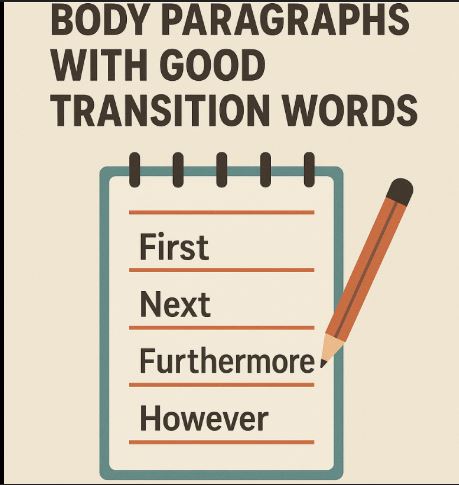
When it comes to writing a powerful argumentative essay, few things are as underestimated yet as crucial as transition words in the first body paragraph. These little connectors are the unsung heroes of persuasive writing — guiding readers smoothly from one idea to another and helping you build a logical, convincing case. Whether you’re a student trying to make your writing flow like a professional’s.
- Understanding the Role of Transition Words in Argumentative Essays
- Why the First Body Paragraph Matters the Most
- Types of Transition Words for the First Body Paragraph
- Building Flow: How Transition Words Strengthen the Argument
- Common Mistakes When Using Transition Words
- Strategic Placement of Transition Words
- Examples of Effective Transition Use in the First Body Paragraph
- The Psychology of Flow and Reader Engagement
- How Transition Words Reflect Professionalism
- Advanced Techniques for Using Transition Words Smoothly
- Balancing Logic and Style with Transition Words
- Transition Words and the Art of Persuasion
- Practical Examples of Transition Words in Action
- Common Pitfalls and How to Avoid Them
- The Relationship Between Coherence and Transitions
- How Transition Words Enhance Academic Tone
- Integrating Transitions with Evidence and Examples
- How to Teach Transition Words Effectively
- Evolution of Transition Usage in Modern Writing
- The Subtle Art of Tone Shifting Through Transitions
- How Readers Perceive Transition Strength
- Final Thoughts: Why Transitions Define Good Writing
In this detailed guide, we’ll explore what these transition words are, why they matter so much, and how you can use them effectively in your first body paragraph — the foundation of every solid argumentative essay.
Understanding the Role of Transition Words in Argumentative Essays
Before diving into transition words for argumentative essays first body paragraph, it’s important to understand what transition words actually do. Transition words are like traffic signals in your writing — they tell readers when to pause, when to move forward, and how to connect one idea to the next. Without them, your essay feels disjointed and difficult to follow.
In argumentative essays, transitions take on an even more powerful role. Since your goal is to persuade the reader to accept your point of view, every sentence must connect logically to the one before it. The first body paragraph is where your argument truly begins, and using the right transition words for argumentative essays first body paragraph sets the tone for everything that follows. It shows that you’re not just throwing opinions on the page — you’re building a structured, reasoned argument.
Think of your essay as a courtroom. The introduction presents your opening statement. But it’s in your first body paragraph that you start laying out evidence. Here, the right transition words for argumentative essays first body paragraph act like verbal bridges — moving your reader seamlessly from your thesis to your first piece of proof. Without those bridges, your argument might lose strength or clarity.
Why the First Body Paragraph Matters the Most
Many writers underestimate how important the first body paragraph is. This section carries a huge burden — it has to introduce your first major point, connect it back to your thesis, and convince readers that your argument has real merit. That’s a lot to accomplish in just one section.
This is exactly where transition words for argumentative essays first body paragraph come in. They help you guide readers smoothly into your first piece of reasoning. For instance, if your essay argues that remote learning improves productivity, your first body paragraph might start with a transition like To begin with, or First and foremost, followed by your main claim. From there, transitions like because, as a result, or this demonstrates that keep your reasoning connected and coherent.
The reason the first body paragraph matters so much is that it sets the rhythm for your argument. Once your reader experiences clear, flowing logic, they’re more likely to trust your reasoning in later paragraphs. That’s why professional writers always emphasize transition words for argumentative essays first body paragraph — they establish not only clarity but also tone and confidence.
Types of Transition Words for the First Body Paragraph
When using transition words for argumentative essays first body paragraph, not all transitions serve the same purpose. Some help you introduce ideas, others show cause and effect, while others help contrast or emphasize points. Understanding these categories helps you choose the right one for each sentence.
Introductory Transitions are ideal for the start of your first body paragraph. Phrases like To begin with, Initially, or The first reason is that signal to the reader that you’re moving from the introduction to your first argument. These are the anchors that mark a shift from general overview to specific analysis.
Cause-and-Effect Transitions show relationships between actions and outcomes. Words like therefore, as a result, consequently, and this leads to help you show logical progression — a must in argumentative writing.
Contrast and Comparison Transitions help you show differences or similarities, often used to strengthen your reasoning. For example, on the other hand, in contrast, or similarly guide readers through nuanced perspectives, proving that your argument is balanced and well-considered.
Emphasis Transitions add weight to important ideas. Words like indeed, in fact, and most importantly draw attention to key evidence or reasoning. Using these strategically in your first body paragraph ensures that readers don’t miss your strongest points.
Building Flow: How Transition Words Strengthen the Argument
A great essay feels seamless. You never notice where one idea ends and another begins — they just flow naturally. That smoothness is the magic of transition words. The best writers use transition words for argumentative essays first body paragraph to make sure their logic feels inevitable, not forced.
Imagine reading two versions of the same paragraph. The first one jumps from point to point without warning — it’s confusing, abrupt, and exhausting. The second uses transitions like for instance and this shows that to connect each sentence naturally. The difference in readability is dramatic.
Good transitions don’t just connect ideas — they also clarify relationships. When readers see words like because or therefore, they instantly understand that what follows is a reason or consequence. When they see however, they expect a counterpoint. This predictability makes your writing easier to follow and more persuasive. That’s why focusing on transition words for argumentative essays first body paragraph can instantly elevate your essay’s professionalism.
Common Mistakes When Using Transition Words
Even though transition words for argumentative essays first body paragraph are powerful tools, they can easily be overused or misused. One of the most common mistakes students make is forcing transitions where they don’t fit. Writing however or therefore just to sound formal doesn’t always make logical sense. Transitions only work when the connection between ideas is real.
Another mistake is repetition. Using for example three times in one paragraph can make your writing sound mechanical. Instead, mix it up with for instance, to illustrate, or such as. The goal is variety without losing clarity.
Finally, some writers treat transitions like decorations — adding them at the end just to tick a box. But the best transition words for argumentative essays first body paragraph are planned intentionally. They’re part of the essay’s rhythm and reasoning, not just filler.
If you find yourself using transitions too frequently, read your paragraph aloud. If it feels choppy or overly formal, you might need to simplify. The best transitions are invisible — they guide your reader without drawing attention to themselves.
Strategic Placement of Transition Words
Using transition words for argumentative essays first body paragraph effectively isn’t just about choosing the right word; it’s also about knowing where to place it. The positioning of transitions determines how smoothly your ideas connect.
At the beginning of the paragraph, transitions like To begin with or The first point to consider is that help signal the start of your reasoning. These mark a clear shift from the introduction to your argument.
Within the body of the paragraph, transitions like because, as a result, or this suggests that help maintain logical flow between sentences. They ensure that every statement builds upon the one before it.
Finally, at the end of the paragraph, transitions like therefore, thus, or consequently help you wrap up your reasoning and hint at the next point. These create a smooth bridge between paragraphs, keeping your essay cohesive from start to finish.
By placing transition words for argumentative essays first body paragraph thoughtfully, you transform your writing from fragmented to fluid.
Examples of Effective Transition Use in the First Body Paragraph
Let’s put theory into practice. Imagine your essay argues that “online education improves accessibility to quality learning.” Here’s how transition words for argumentative essays first body paragraph can bring structure and flow.
Without transitions:
“Online education offers access to many students. It helps people learn at their own pace. Students can balance work and study.”
With transitions:
To begin with, online education offers access to many students who might not otherwise attend traditional schools. In fact, it helps people learn at their own pace and from any location. As a result, students can balance work and study more effectively.
The second version reads more professionally and persuasively. The transitions guide readers smoothly through each supporting idea. That’s the essence of mastering transition words for argumentative essays first body paragraph — they make your argument clear and engaging without overwhelming the reader.
The Psychology of Flow and Reader Engagement
There’s a reason transitions work so well — they match how the human brain processes information. When readers encounter transition words for argumentative essays first body paragraph, their minds instinctively prepare for what comes next. Words like because or however create expectations, helping readers anticipate logical relationships.
Psychologists call this cognitive priming. Essentially, transitions act as mental cues, allowing readers to process complex arguments more easily. That’s why essays without transitions often feel confusing or tiring to read — the brain has to work harder to find the logical connection.
By using the right transition words for argumentative essays first body paragraph, you’re not only improving your style but also guiding your reader’s thought process. You’re building trust by making your argument easy to follow, which is exactly what strong persuasive writing requires.
How Transition Words Reflect Professionalism
Teachers, editors, and readers can always tell when a writer knows how to use transitions. The difference is subtle but powerful. Using transition words for argumentative essays first body paragraph correctly signals that you understand structure, logic, and reader experience. It shows mastery of writing fundamentals — and that’s something every skilled communicator has in common.
Professional writing, whether in academia, journalism, or content creation, relies heavily on transitions. It’s not about sounding fancy — it’s about being clear. When you can move smoothly from one point to another, you demonstrate confidence in your argument.
Even more importantly, transitions show respect for your reader. They make your essay easier to follow and your reasoning more accessible. That’s why every experienced writer treats transition words for argumentative essays first body paragraph as an essential tool, not just a stylistic flourish.
Advanced Techniques for Using Transition Words Smoothly
Once you’ve mastered the basics, it’s time to elevate your technique. Using transition words for argumentative essays first body paragraph effectively isn’t just about inserting them — it’s about making them feel organic within your writing. The best transitions blend so naturally that the reader doesn’t even notice them.
One advanced method is contextual linking. This means instead of using generic transitions at the start of every sentence, you weave them into your argument. For example, instead of writing Therefore, online learning is effective, you might say, This accessibility therefore makes online learning a practical solution for modern students. The transition flows naturally without feeling forced.
Another technique is variation through synonym use. If your essay frequently uses transitions like for example, try alternating with to illustrate, specifically, or as an instance. The variety keeps your writing fresh while maintaining logical flow. Repetition of the same transitions can make even strong arguments feel robotic, so subtle variation is key.
Finally, consider tone consistency. Some transitions carry a formal tone (therefore, consequently), while others sound more conversational (in the same way, on top of that). Choose transitions that match your essay’s style and tone. Academic essays usually benefit from more formal transitions, while reflective or opinion-based essays can comfortably use softer ones. This adaptability is what defines a writer who truly understands transition words for argumentative essays first body paragraph.
Balancing Logic and Style with Transition Words
Using transition words for argumentative essays first body paragraph should always support two goals — logical flow and stylistic balance. Too many transitions can make your writing sound mechanical, while too few make it sound abrupt. The key lies in knowing when your argument needs a bridge and when it can stand on its own.
When establishing your first argument, transitions often appear at the beginning and middle of sentences. For instance, To begin with, introduces your first claim, while as a result connects it to supporting evidence. But sometimes, a strong piece of reasoning doesn’t need a transition because the logic speaks for itself. Skilled writers recognize when to let ideas breathe.
Stylistically, transitions can also set the tone of persuasion. Words like undeniably or clearly add confidence to your writing. Others, like perhaps or it could be argued that, introduce subtlety. Balancing these types within your transition words for argumentative essays first body paragraph ensures that your essay sounds assertive but fair-minded — a hallmark of effective argumentation.
Transition Words and the Art of Persuasion
At its heart, an argumentative essay is an exercise in persuasion — and persuasion thrives on clarity and flow. Every argument you present depends on your reader’s ability to follow your reasoning step by step. That’s exactly why transition words for argumentative essays first body paragraph are indispensable.
Persuasion isn’t just about presenting facts; it’s about guiding the reader through them. Transitions create that invisible thread that ties your evidence and logic together. When you write, For this reason, students who study online often achieve higher satisfaction levels, you’re not just making a claim — you’re linking it to previous evidence, showing readers how your ideas connect.
Moreover, transitions convey confidence. They tell your reader, I know where this argument is going, and I’ll lead you there clearly. That confidence makes your essay sound authoritative. Without transitions, even solid arguments can come across as scattered or uncertain.
In essence, transition words for argumentative essays first body paragraph give structure to persuasion — they’re the signposts that keep your reader walking the path you’ve built, step by step, toward agreement.
Practical Examples of Transition Words in Action
Seeing transitions in context often helps writers understand how they function dynamically. Let’s explore a few more examples that demonstrate how to use transition words for argumentative essays first body paragraph naturally and effectively.
Example One:
To begin with, the growing accessibility of digital tools has made education more inclusive than ever before. In fact, learners from rural areas now have access to high-quality instruction that was once limited to large cities. As a result, digital education promotes equality by breaking down geographical barriers to learning.
Example Two:
Initially, many critics doubted the effectiveness of online classes. However, research now shows that virtual classrooms can produce results comparable to traditional ones. Therefore, the argument that online education is inferior no longer holds strong ground.
Each example uses transition words for argumentative essays first body paragraph to connect ideas logically while maintaining rhythm and flow. Notice how the transitions aren’t just fillers — they reinforce relationships between sentences. That’s what makes them powerful tools rather than decorative phrases.
Common Pitfalls and How to Avoid Them
Even advanced writers occasionally misuse transitions. The biggest pitfall is redundancy — using transitions that repeat the same meaning within a few lines. For instance, starting three consecutive sentences with Furthermore can weaken the impact of your argument. Instead, alternate with in addition, what’s more, or restructure the sentence to flow naturally without one.
Another pitfall is misalignment — using transitions that don’t fit the logic. Writing however when you’re not introducing a contrast, or therefore when no conclusion follows, confuses readers. Always double-check that your transition matches the logical relationship between the two ideas.
Finally, avoid overcrowding. Using too many transition words for argumentative essays first body paragraph can make your writing seem cluttered. Transitions should enhance your argument, not overwhelm it. The best practice is moderation: one strong transition per logical connection is usually enough.
When used with precision, transitions elevate your essay. When used carelessly, they distract from it. The difference lies in intention and awareness.
The Relationship Between Coherence and Transitions
One of the most overlooked benefits of transition words for argumentative essays first body paragraph is the way they enhance coherence. Coherence refers to the smooth, logical connection between ideas — the glue that holds your essay together. Without it, even the most well-researched arguments can feel fragmented.
Transitions ensure coherence by guiding readers through your reasoning. Each transition word signals how one sentence relates to the next — whether it supports, contrasts, or concludes. For instance, when you say in contrast, the reader immediately understands that a shift in perspective is coming. This consistency of expectation builds trust and comprehension.
Coherence also makes your argument memorable. Readers are more likely to retain information that’s well-structured because it’s easier to follow. By skillfully using transition words for argumentative essays first body paragraph, you not only make your essay persuasive but also intellectually satisfying.
How Transition Words Enhance Academic Tone
Another reason to master transition words for argumentative essays first body paragraph is their ability to enhance academic tone. Academic writing values clarity, precision, and formal structure — all of which transitions support beautifully.
In academic essays, transitions demonstrate control over your material. They show that you understand how ideas interact, and that your argument isn’t just a collection of random points. For instance, using consequently or thus at the right time reveals logical discipline, while moreover or in addition shows your ability to extend ideas systematically.
Even beyond logic, transitions contribute to professionalism. A paper with smooth transitions feels polished, while one without them feels rushed. Teachers and readers immediately notice this difference. That’s why understanding transition words for argumentative essays first body paragraph is more than a stylistic skill — it’s part of academic integrity.
Integrating Transitions with Evidence and Examples
Strong arguments depend on evidence, and evidence must be introduced smoothly. This is where transition words for argumentative essays first body paragraph truly shine. They help blend data, quotations, and examples naturally into your discussion.
For instance, instead of writing:
“Students perform better in hybrid models. A study from Harvard shows this result,”
you could write:
“Students perform better in hybrid models. For example, a study from Harvard shows this result.”
The transition for example instantly clarifies the relationship — the second sentence supports the first. Similarly, transitions like according to, as demonstrated by, or as supported by help integrate evidence with elegance and clarity.
This connection between transition words and evidence transforms your essay from mechanical to persuasive. It ensures that every piece of information strengthens your claim rather than feeling randomly inserted.
How to Teach Transition Words Effectively
Teachers and tutors often struggle to explain transitions clearly. A practical approach is to focus specifically on transition words for argumentative essays first body paragraph before moving on to the rest of the essay. This helps students grasp how transitions function in the foundation of argumentation.
Start by modeling examples. Show students a paragraph with no transitions and then one with them. The contrast makes the benefit immediately clear. Next, encourage them to identify transitions by type — whether they introduce, connect, or conclude.
Another effective strategy is to have students highlight transitions in color codes during revision. This visual exercise reveals patterns, showing where they might have overused or underused transitions. Over time, this habit helps them internalize where and how to place transition words for argumentative essays first body paragraph effectively.
Evolution of Transition Usage in Modern Writing
Interestingly, the way we use transition words for argumentative essays first body paragraph has evolved alongside digital communication. In earlier decades, academic writing favored rigid transitions like therefore and henceforth. Today’s writers lean toward clarity and readability, using smoother, more conversational transitions.
This evolution reflects a broader shift toward accessibility in education. Readers — especially online readers — prefer essays that sound natural and engaging. That’s why modern writing blends formal transitions with friendly tone. Words like for instance or on the other hand feel conversational yet still maintain academic precision.
Understanding this evolution helps you adapt your style. You don’t have to sound overly stiff to be persuasive. A modern essay that uses transition words for argumentative essays first body paragraph naturally will always connect better with contemporary audiences.
The Subtle Art of Tone Shifting Through Transitions
Tone shifts are common in argumentative essays — you might move from introducing a claim to presenting a counterpoint or emphasizing consequences. The beauty of transition words for argumentative essays first body paragraph is that they let you shift tone without jarring the reader.
For example, however can pivot from agreement to disagreement gracefully. Nevertheless softens opposition, maintaining politeness. More importantly elevates urgency without sounding aggressive. These subtle transitions help you navigate complex emotional and intellectual tones seamlessly.
Writers who master this skill can persuade without sounding confrontational, balancing assertiveness with respect. In other words, transitions become emotional as well as logical tools — capable of shaping not just understanding but also perception.
How Readers Perceive Transition Strength
Readers subconsciously evaluate the strength of your writing through its flow. Smooth, logical progression signals competence. Choppy, abrupt movement signals inexperience. This is why transition words for argumentative essays first body paragraph carry so much weight.
When readers encounter transitions that make perfect sense, they relax and engage more deeply. They trust that you’re leading them somewhere meaningful. But when transitions are missing or misused, they feel lost — and in argumentation, confusion is the enemy of persuasion.
Professional writers understand that transitions are like music notes. Too few, and your essay feels monotonous; too many, and it feels chaotic. Finding that balance through careful use of transition words for argumentative essays first body paragraph is how you make your writing sing.
Final Thoughts: Why Transitions Define Good Writing
If there’s one thing to take away from this exploration of transition words for argumentative essays first body paragraph, it’s that transitions are not decorative — they are structural. They give your ideas shape, direction, and clarity.
In your first body paragraph, transitions are your most powerful allies. They turn isolated statements into logical arguments and transform readers from passive observers into active participants. Every great writer knows this truth: clarity is persuasion. And transitions are the pathway to clarity.
So the next time you draft an argumentative essay, pay attention to those connecting words. Experiment with different types. Read your paragraphs aloud to feel the rhythm. And remember — mastering transition words for argumentative essays first body paragraph isn’t just about writing better essays. It’s about thinking more clearly, reasoning more effectively, and communicating more powerfully.